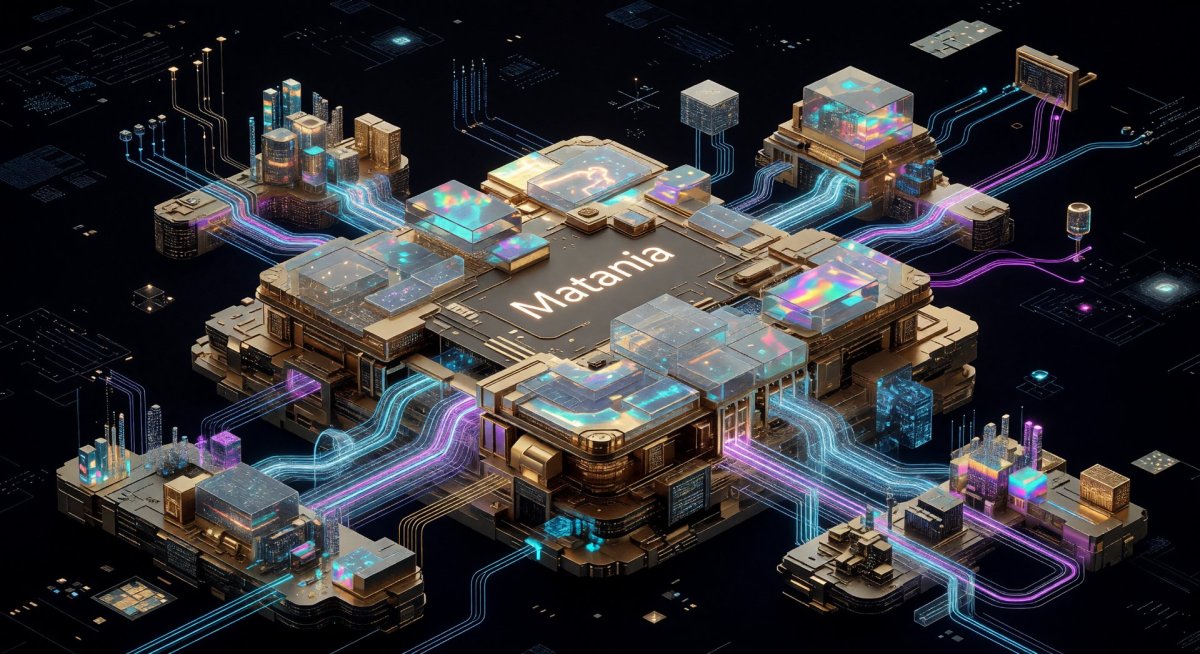
ProductivIA today announces the availability of its Matania orchestration platform in 11 languages, marking a key milestone in the development of a new generation of artificial intelligence infrastructure: modular, multi-model, and sovereign by design.
Born out of the work carried out around the ProductivIA platform, Matania is not positioned as yet another AI model, but as a strategic orchestration layer designed to leverage multiple artificial intelligences simultaneously — local or international — within a unified, controlled, and scalable framework.
Rethinking AI: from a single model to multi-engine orchestration
Today’s artificial intelligence market is dominated by powerful models that are closed, centralized, and difficult to interchange. This dependency creates a structural risk for organizations:
- technological dependence,
- loss of control over data,
- difficulty evolving quickly as the market advances.
Matania offers a clear alternative:
a multi-engine architecture capable of dynamically selecting, combining, and replacing AI models without affecting applications or data.
This approach makes it possible to:
- switch models at any time without rebuilding systems,
- preserve data, learned behavior, and business logic,
- optimize each task by using the most relevant engine,
- and ensure structural resilience in the face of rapid AI evolution.
Digital sovereignty as a technical foundation, not a talking point
Matania integrates sovereignty directly into its architecture, not as a secondary constraint.
The platform enables:
- full control over data flows (local, private, or hybrid),
- the ability to prioritize local or open-source models,
- granular management of calls to external models (with filtering, anonymization, or restriction),
- and the ability to operate in isolated or critical environments.
Sovereignty therefore becomes an operational capability, not a promise.
ProductivIA: a foundation built for usage and performance
Matania is part of the ProductivIA ecosystem, a platform designed to turn AI into a practical tool for production and operational performance.
Where ProductivIA structures use cases (assistants, automation, business tools),
Matania acts as the orchestration brain that decides in real time:
- which model to use,
- at what cost,
- with what level of performance,
- and under which security constraints.
This combination makes it possible to build solutions that are:
- faster to deploy,
- more robust over time,
- and independent from vendors’ innovation cycles.
11 languages: truly global orchestration
Matania’s availability in 11 languages is not merely a functional extension, but a structural part of its vision.
It makes it possible to:
- deploy consistent AI systems in multilingual environments,
- orchestrate language-specific specialized models,
- and adapt interactions to cultural and operational contexts.
Orchestration is no longer limited to models — it now extends to linguistic contexts and real-world use cases.
An infrastructure for the AI systems of tomorrow
With Matania, artificial intelligence evolves from a point solution into a strategic infrastructure:
- Multi-model: leverage the best of each AI
- Interoperable: integrate new engines quickly
- Resilient: eliminate dependence on a single provider
- Sovereign: retain control over data, costs, and business logic
- Scalable: keep pace with innovation without disruption
This approach enables organizations to build systems today that can adapt to the models of tomorrow.
Availability
Matania is now available in 11 languages:
ProductivIA:
About Matania
Matania is an artificial intelligence orchestration platform designed to coordinate, supervise, and optimize the use of multiple AI models within a unified environment. It enables the creation of high-performance, scalable, and sovereign systems that can continuously adapt to technological advances.
About ProductivIA
ProductivIA is a platform dedicated to the operational integration of artificial intelligence within organizations. It transforms the capabilities of AI models into practical tools for productivity, automation, and value creation.